The timing mismatch
Peak sun is around midday. Peak hot water use is between five and nine in the evening. Everything the panels earned during the day gets spent in a four-hour window, and the morning shower is at the back of the queue.
You spent good money on solar and you are still getting into a cold shower at 6am. An inline gas geyser sits after your solar system and tops the water up only when the sun has not done enough. we fit Paloma and Rinnai inline setups across George and the Garden Route — call 071 551 2108.
You invested in solar but your morning showers are still cold. You are not alone — it is the most common complaint we hear from solar homeowners in George. The panels work, the tank gets properly hot by mid-afternoon, and then the family arrives home, three people shower, the dishes get done, and by the next morning there is nothing left but lukewarm water and a grumpy household.
Nothing is broken. Solar is doing exactly what solar does. The gap is storage: a tank holds a fixed amount of hot water and once it is gone, it is gone until the sun comes back. An inline gas geyser closes that gap without asking you to abandon the system you already paid for.
This is some of our favourite work. It is a proper problem-solving job rather than a swap-out, and it is one of the reasons people call us the gas geyser hospital of George rather than just another installer.
Because solar heats during the day and your household uses the hot water at night. By morning the tank has been sitting for eight to twelve hours, losing heat and holding whatever was left over after the evening rush. The system is not faulty — it has simply run out of stored water.
Peak sun is around midday. Peak hot water use is between five and nine in the evening. Everything the panels earned during the day gets spent in a four-hour window, and the morning shower is at the back of the queue.
A grey, drizzly week on this coast is normal. Two or three overcast days in a row and the tank never gets properly up to temperature at all, so the shortfall shows up in the evening as well as the morning.
Most solar tanks have an electric element as backup. It works, but it heats the whole tank whether you need 20 litres or 200, usually overnight at full tariff, and it is dead during load shedding. That is the bill people are trying to escape.
The other symptom we hear is hot then cold — the shower starts fine, someone opens a tap in the kitchen, and it drops away. That one is usually a mixing or flow problem rather than a solar one, and it is covered on our fault diagnosis page. If you are unsure which of the two you have, describe it on the phone and we will tell you.
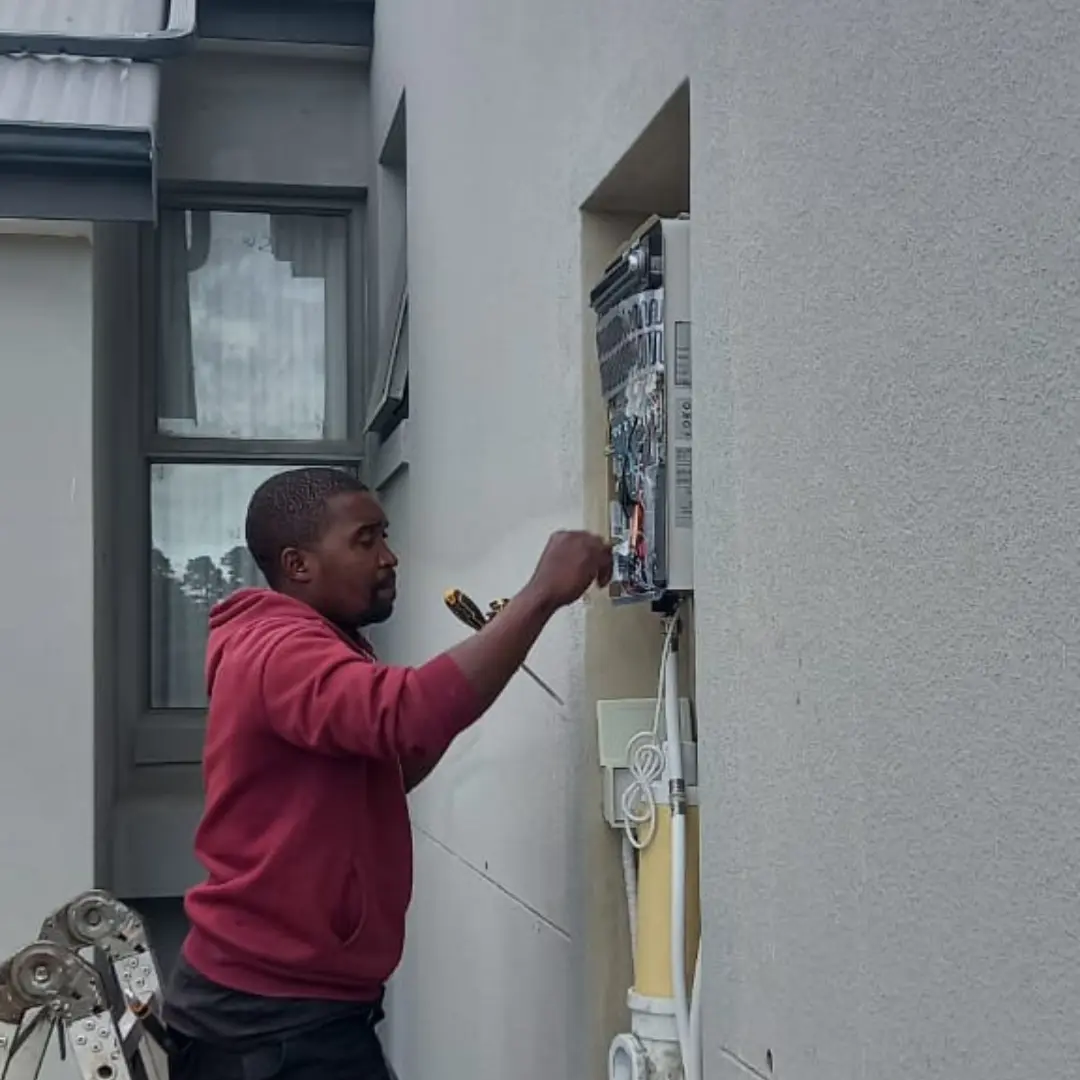
The gas geyser is plumbed in after the solar system, on the hot water line heading to the house. It constantly reads the temperature of the water arriving from your tank. If that water is already at or above your set temperature, the burner never lights and the water passes straight through. If it is cold, the unit fires and heats it to the preset temperature on its way to the tap.
Your panels or PV element carry on doing exactly what they do now. Nothing is disconnected and nothing is downgraded. The free heat gets used first, every single day.
Paloma and Rinnai constant-temperature units have an inlet sensor. They know the difference between 48°C water off a good solar day and 16°C water in the middle of July.
The burner modulates — it does not run flat out or not at all. Water arriving at 35°C gets a gentle lift to your set 50°C. You burn the gas needed for that gap and nothing more.
The output holds steady even as the solar contribution changes through the day. That is what makes mixer taps behave properly instead of swinging hot and cold.

Only the Paloma 20L and the Rinnai 20L. Both are constant-temperature units that read the incoming water and modulate the burner to suit it. Battery-powered units like the Dewhot 16L and the Cadac 16L Eco are not designed for preheated water and we will not fit them inline, even if you ask.
One of our two premium units. Twenty litres a minute is enough for a whole house, it handles mixer taps without sulking, it needs no weather cover on the coast, and its temperature control inline is the best of the five models we supply. It needs a weatherproof plug point near the unit. From around R22,000 installed.
Paloma 20L installationAlso constant temperature, also electricity-dependent, also mixer-tap friendly and solar-inline capable. It is the sensible choice when the budget matters but the performance cannot slip. From around R21,500 installed.
Rinnai 20L installationThe Dewhot 16L and Cadac 16L Ecoflow are good honest geysers in the right application — small homes, flats, granny flats, cold-feed installations. Inline is not the right application. They expect cold water at the inlet, and warm water confuses their control, which shows up as cutting out, scalding swings or a burner that will not stay lit. We would rather lose the sale than fit a unit that turns into a callout every second week. If a flat or granny flat is what you are kitting out, look at gas geysers for flats and granny flats instead.
The same as that unit's normal installed price: from around R22,000 for a Paloma 20L and from around R21,500 for a Rinnai 20L. There is no solar surcharge. What moves the number is your plumbing layout — how far the gas line has to run, where the cylinder stands, and whether a plug point already exists.
we quote after seeing the property, not over the phone from a guess. Every installation is issued with a Gas Certificate of Compliance. If you want to compare the models side by side first, the buying guide lays them out honestly.
Inline jobs need someone who will come back and fine-tune the temperature once you have lived with it for a week. That is the part people mention in their reviews.
“Very knowledgeable in gas and water”
“Returned several times until it worked properly”
“From beginning to end superb”
In most cases yes. If you have a solar water heating tank on the roof or a PV-fed element in a storage geyser, the gas unit simply goes in the hot water line after that tank and before the taps. we come out, looks at where the tank sits, where the hot line runs and where a cylinder and a plug point can go, and tells you honestly whether the layout works. Odd cases exist — a tank in a ceiling with no accessible hot line, for instance — and you will hear that on the day rather than after a deposit.
Our first choice for inline solar work — constant temperature, mixer-tap friendly, no weather cover needed on the coast.
Read moreThe same inline capability at a lower installed price. A strong option when the budget is tighter but performance cannot slip.
Read moreThe full installation hub: all five models, what a compliant install includes, and how we size a unit to your household.
Read moreTell us what solar you have, how many people shower in the morning and where your hot water line runs. He will tell you whether an inline gas geyser fixes it, which unit suits the house, and what it will cost — before anyone commits to anything.